Log File Integrity Monitor

Detects tampering with log files — rewrites, truncation, deletion and timestamp forgery — using nothing but Bash and the utilities already on the box.

bash 3.2+ dependencies none Linux · macOS · BSD 73 test assertions MIT

Hashing log files is harder than it looks

When someone breaks into a host, editing /var/log/auth.log is step one of covering their tracks. The obvious defence — hash the files, compare later — falls apart on the one kind of file it is needed for.

The naive approach

md5sum -c auth.log.md5 fails every few seconds, because log files grow by design. sshd writes to it. sudo writes to it. cron writes to it.

So the alert fires constantly, somebody mutes it "until we have time to tune it", and nobody ever has time. When it finally matters, the channel is off.

What LogSentry asks instead

Given that the file was S bytes and hashed to H at baseline time — does the first S bytes of the file today still hash to H?

If yes, everything already written is intact and the file was only appended to. No alert. If no, something rewrote history, and that is not a thing well-behaved daemons do.

One comparison, three outcomes

That single distinction is the difference between a tool you deploy and a tool you mute.

   baseline    [ 517 bytes, md5 = 4f3a…9c ]

   append      [ 517 bytes, md5 = 4f3a…9c ][ 95 new bytes ]   prefix matches   → INFO
   rewrite     [ 517 bytes, md5 = b81e…07 ][ 95 new bytes ]   prefix differs   → HIGH
   truncate    [ 190 bytes                ]                   file shrank      → CRITICAL
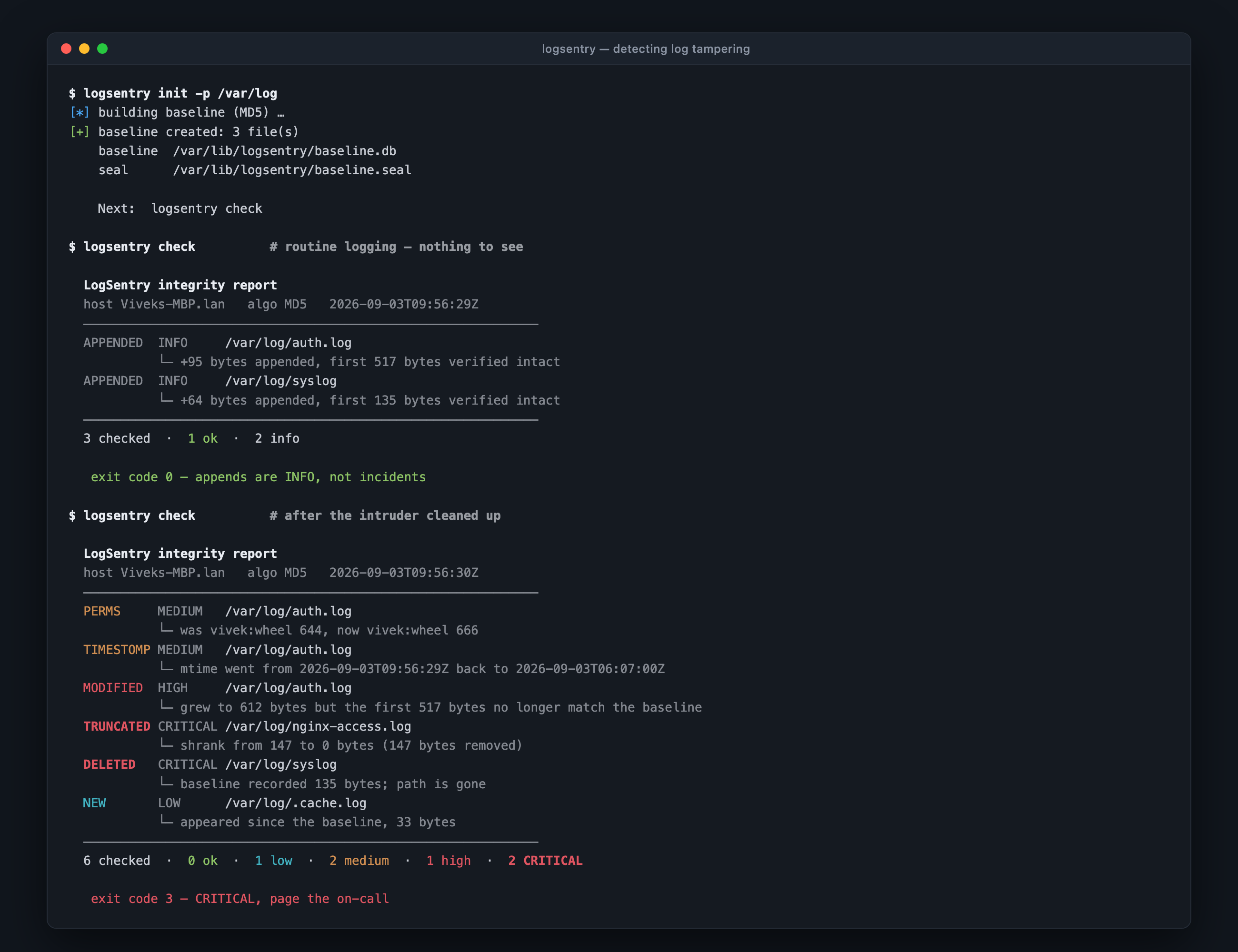
LogSentry detecting six kinds of log tampering in a terminal
Real output: routine appends stay quiet, then six findings after a simulated intrusion.
VerdictSeverityWhat actually happenedExit
APPENDEDINFONew lines added, earlier bytes verified intact — normal logging0
ROTATEDINFONew inode with an archived copy alongside — logrotate did its job0
NEWLOWA file appeared in a monitored directory since the baseline1
PERMSMEDIUMMode, owner or group changed1
TIMESTOMPMEDIUMmtime moved backwards — timestamps were forged1
MODIFIEDHIGHBytes that already existed were rewritten — log history was altered2
TRUNCATEDCRITICALThe file shrank — a partial or total log wipe3
DELETEDCRITICALA baselined file is gone3
SEALCRITICALThe baseline itself was edited after it was sealed3

Built to be deployed, not just demoed

The parts that decide whether a security tool survives contact with production.

No dependencies

On a host you have started to distrust, pip install is not a step you get to take. Bash plus what the OS ships.

GNU and BSD

stat flags and digest tools differ across platforms. CI runs the suite on Ubuntu and macOS, so the claim is tested.

Severity exit codes

0 clean, 1 low, 2 high, 3 critical. Cron and systemd act on the result without parsing a line of output.

Five alert sinks

Console, ECS-shaped JSONL, syslog via logger, Slack/Teams via curl, email via mail.

A sealed baseline

The attacker's next move is editing the baseline. Optional HMAC-SHA256 with the key held off the host.

Config is never sourced

Sourcing would hand root to anyone who can write the config. Parsed by hand, unknown keys rejected, regression-tested.

Quick start

No installation required — it runs straight from a clone.

# Clone and watch it catch a simulated intrusion, in a sandbox
git clone https://github.com/Dc0der-X/Log-File-Integrity-Monitor.git
cd Log-File-Integrity-Monitor
./demo/demo.sh

# Then point it at something real
sudo ./bin/logsentry init  -p /var/log/auth.log -p /var/log/syslog
sudo ./bin/logsentry check

# Install with a scheduler (detects systemd, launchd or cron)
sudo ./install/install.sh --with-timer

init records the baseline. check compares against it. That is the whole mental model.

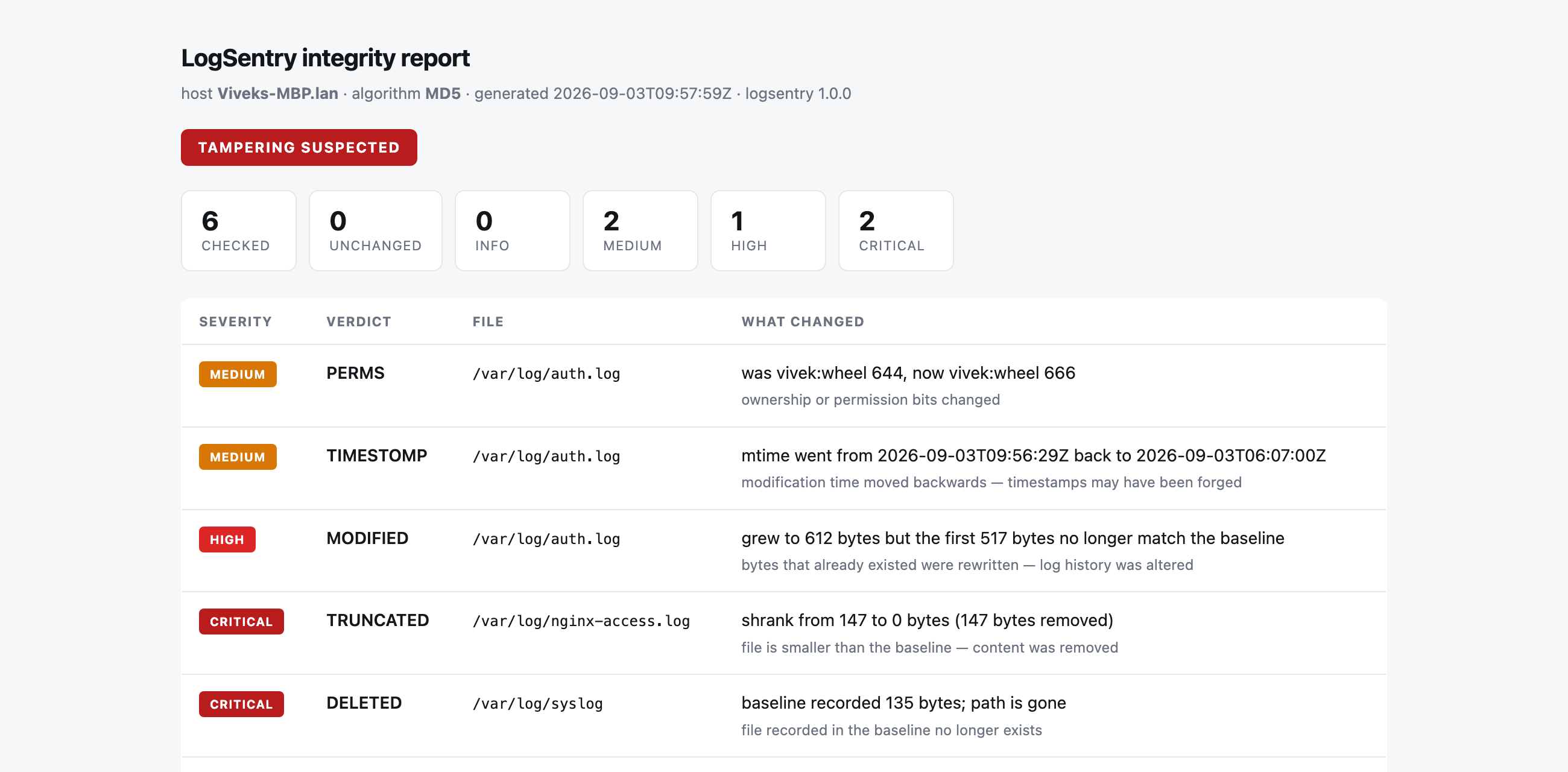
The self-contained HTML integrity report
Self-contained HTML report — no external CSS, no web fonts, no JavaScript. It opens on an air-gapped forensics laptop.

Documentation

Four deep-dive documents, not an afterthought.